
Bonjour à toutes et à tous,
Le troisième épisode est consacré aux six derniers mois.
Je vous préviens, c’est long !
Pour celles et ceux qui viennent d’arriver, le premier épisode sur l’histoire de la machine ultime est ici et le second consacré aux makers est là.
Janvier
J’ai donc commencé à m’y mettre en janvier 2024. Dans la grisaille.
Avec comme vague objectif de construire un prototype permettant de montrer le côté vivant de la machine, mais avec une forme différente, inhabituelle.
Mécano (du dimanche)
Concernant la mécanique, les fichiers 3D ne manquent pas. Je m’en suis inspiré pour comprendre le mécanisme.
C’est assez simple me direz-vous, mais la mécanique n’est pas mon fort : pendant mes études d’ingénieur, je me rappelle avoir dû étudier les plans d’un mitigeur pendant deux heures sans parvenir à comprendre où passait l’eau chaude (en revanche, j’avais fait des taches d’encre partout avec mon Rotring).
J’ai donc remis en route la Prusa et, le 12 janvier, j’ai décidé de faire ce que je ne fais jamais : suivre un cours en ligne sur Autodesk Fusion. Jusqu’ici j’utilisais TinkerCad, mais là, j’ai senti que j’allais devoir passer à la vitesse supérieure. J’ai donc consacré une quinzaine d’heures à écouter et regarder un certain Nicolasexpliquer les différentes fonctions de Fusion.
Les premiers résultats n’étaient pas glorieux, mais au moins je comprenais un peu comment tout cela allait fonctionner. Et j’ai décidé de n’utiliser qu’un seul moteur, alors que beaucoup de boîtes en comportent deux : l’un pour soulever le couvercle et l’autre pour repousser l’interrupteur. Les premiers essais m’ont montré qu’on pouvait faire les deux avec un seul moteur, en gardant la possibilité de créer un langage avec les mouvements d’ouverture (le côté vivant).

Un premier essai de forme… étrange
Pour échapper à la forme traditionnelle de la boîte, j’ai conçu un premier prototype à l’allure, comment dire… indéfinissable. Je crois que je venais juste de comprendre comment faire des objets en révolution avec Fusion.
Je l’ai peinte en jaune, et le bras en rose, parce qu’il y avait suffisamment de gris dehors. Le tout est en images dans cette vidéo.

Le premier problème de ce prototype était que le scotch qui tenait le couvercle provoquait inévitablement la remarque « c’est chouette mais tu vas garder le scotch, là ? ».
Venait un second problème dû au fait que les fils qui sortaient de la boîte provoquaient inévitablement la remarque « mais il va y avoir tous ces fils, là ? ».
Ah, et j’avais aussi commencé à travailler sur une version en carton, avec une idée derrière la tête.

Février
Premier chantier : l’électronique (le monstre)
Suite au prototype jaune, il a fallu intégrer l’électronique dans la boîte. J’ai utilisé des cartes qui contiennent déjà les composants, des breakboards que l’on relie tant bien que mal avec des petits câbles, en faisant un usage immodéré du pistolet à colle, tout en priant pour que ça fonctionne.

Second chantier : le premier prototype
Il a fallu ensuite réaliser une vraie boîte, avec un vrai couvercle garanti sans scotch, et qui permettrait d’intégrer l’électronique, le moteur, l’interrupteur et le bras.
J’ai opté pour des charnières en laiton et j’ai testé des sons d’inspiration skeuomorphique – piste abandonnée plus tard, mais à ce moment-là, qu’est-ce que j’étais content ! Vous pouvez voir tout ça en action sur cette vidéo.

Mars
Cette première version était “good enough” comme on dit dans l’Yonne, mais l’utilisation de charnières en laiton vissées puis collées au pistocolle ne m’a pas semblé une solution élégante. En regardant des dizaines de fois des dizaines de tutoriels, j’ai fini par dessiner une charnière sans laiton et sans colle, en pur plastique. Victoire.
J’ai également retravaillé la carte électronique pour la faire passer d’un magma de fils à une carte de cartes un peu propre. C’est très simple à réaliser (j’utilise EasyEDA) et très peu cher à faire fabriquer.
Sur cette carte, on trouve une carte avec un rp2040, un ampli audio, une carte qui transforme le 3.7V de la batterie en 5V et une carte qui permet de charger la batterie. L’ensemble fonctionne suffisamment bien pour un prototype (c’est-à-dire mal).
Voici à quoi ça ressemble. C’est mieux, non ?

En tout cas, tous ces efforts ont permis d’aboutir enfin à un premier prototype montrable.

Aussitôt suivi d’un autre prototype un peu plus petit qui allait faire parfaitement l’affaire. J’ai pu enfin rassembler toutes mes idées dans une première vidéo baptisée modestement « Concepts« .

J’avais réalisé une autre vidéo avec d’autres essais de sons que vous pouvez voir ici.
Mon amoureuse m’a ensuite suggéré un nom pour la boîte inutile : la machine. J’ai aussitôt finalisé le logo (enfin, je lui ai trouvé une police de caractère adaptée), déposé la marque “la machine” (refusée depuis) et acheté le nom de domaine la-machine.fr.
J’ai aussi fait fabriquer des badges. Si ça vous intéresse, j’en offre aux 20 premières ou premiers qui me le feront savoir !

Avril
Elium Studio
Elium Studio est une agence de design produit : elle dessine les produits Withings, les Freebox, les afficheurs dans le métro ou les ustensiles McDo et une foule d’autres choses. Je connais Pierre Garner depuis longtemps. Je tenais à ce que ce soit Elium qui travaille sur le design de la boîte. Après consultation de son équipe, Pierre a accepté le projet et mi-avril, je sonnais chez eux pour le brief.

Les ateliers
Vous vous rappelez du prototype en carton ? J’avais une idée en tête : l’utiliser pour des ateliers avec les enfants. Chaque année, j’anime un atelier à l’école de l’Arbalète à Paris (avec mon fils Armand), au cours duquel les enfants construisent un petit objet électronique qu’ils peuvent rapporter chez eux.
L’année dernière, c’était un petit robot fait de gobelets en plastique, qui s’allumait et tournait la tête quand on le touchait. Cette année, ils ont fabriqué une boîte inutile.
Il a fallu concevoir plus sérieusementcette version en papier. Heureusement, je connaissais le monde des paper toys puisque j’avais déjà réalisé (avec Marc) des objets en carton avec de l’électronique dedans. Ça s’appelait reaDIYmate.
Il a fallu faire une carte électronique, acheter le matériel, ressortir la Cricut pour découper le carton et tester le montage pour vérifier qu’on arriverait à le faire en 3h. Résultat : les enfants ont pu rapporter chez eux leur boîte inutile et, pour les plus nerds d’entre eux (ou leur frères, sœurs ou parents), la reprogrammer.

Une deuxième opportunité s’est aussi présentée dans une classe de maternelle où la poétesse Séverine Daucourt était en résidence. Les enfants ont composé des poèmes qu’ils ont dis à haute voix, et les enregistrements ont été mis “dans la boîte”, pour permettre de les réentendre à l’infini.
Ah, et pour les plus grands, je donne un cours à la WSF sur le design physique et cette année on a bien rigolé à faire des boîtes inutiles.
Le logiciel (sérieusement)
Fin avril, j’ai déjeuné (comme souvent) avec mon ami Paul Guyot. Pour ceux qui ne le connaissent pas, il était le directeur technique de Violet, la société liée au Nabaztag. Il a fait des tas de choses depuis, mais c’est lui qui en 2019 avait écrit en Python les services emblématiques du Nabaztag pour le kit TagTagTag. Je lui ai montré le prototype et il m’a proposé de m’aider sur le logiciel qui, bien que paraissant simple, demandait à être abordé professionnellement.
J’étais parti sur un micro-contrôleur connu (le rp2040), mais il consomme beaucoup quand il dort. Il ronfle fort, si on peut dire. Et la consommation est un enjeu important de la boîte – je doute que les gens pensent à recharger leur machine tous les soirs. Il faut une autonomie qui se compte en mois. Paul m’a donc suggéré de prendre un autre processeur (un ESP32 C3 pour les experts) qui a l’avantage d’être peu gourmand en énergie quand il ne fait rien. Le rp2040 est anglais, le C3 est chinois. Je ne sais pas ce que qu’il faut en conclure.
Il m’a aussi incité à utiliser Erlang mais ça, il me le conseille à chaque nouveau projet. Erlang est un langage fonctionnel, proche du LISP. LISP était utilisé par les pionniers de l’IA, dont Marvin Minsky, l’inventeur de la boîte inutile. Vous suivez ? Bref, on est partis sur Erlang il ne me reste plus qu’à l’apprendre (et vous aussi).
Paul a également proposé de donner une conférence sur la machine au festival Erlang à Berlin en octobre. Si vous êtes à Berlin le 20 octobre 2024, venez écouter Paul : le nom de la conférence est “La Machine: The Useless Box reloaded with Erlang and AtomVM« .
Mai
Mai a été consacré en partie à l’expédition des cartes TagTagTag du lot de production 2024. Rien à voir avec la machine, même si parfois j’ai l’impression de refaire une sorte de Nabaztag : ça ne sert à rien, ça joue des sons et il y a un truc qui bouge.

Les ami.e.s
J’ai quand même eu le temps de finaliser l’appel aux ami.e.s de la machine : une vidéo et un premier site réalisés avec les moyens du bord qui m’ont pris un temps infini. En contactant les gens qui s’étaient intéressés au Nabaztag, au Minimit et à Multiplié, j’ai eu très rapidement 300 ami.e.s. Dont vous peut-être.

Interesting
Je suis allé à Londres pour assister à la fabuleuse conférence (vaguement annuelle) de Russell Davis : Interesting. J’en ai profité pour voir l’exposition d’Enzo Mari au Design Museum et visiter quelques boutiques pour repérer quels bidules électroniques inutiles occupaient le marché. Chez Selfridges, j’ai trouvé ces enceintes Bluetooth avec quelques touches de clavier et un mini-écran, tout cela à £129.95. Je me suis dit qu’avec la machine, j’avais peut être ma chance.

L’électronique (sérieusement)
Il était temps de passer aux choses sérieuses pour l’électronique. C’est là qu’est intervenu Philippe Debadier. Philippe Debadier est l’ingénieur qui a conçu l’électronique du Nabaztag il y a longtemps et des centaines d’autres cartes électroniques depuis. Il a accepté de m’aider et a réalisé celle de la machine.
Le schéma, le routage (le routage consiste à passer d’un schéma électrique théorique à une carte dans la vraie vie) et les prototypes sont terminés.
Reste à tester. Merci Philippe !

Juin
Elium Studio (again)
Le 17 juin, j’avais rendez-vous avec Elium pour le rendu des premiers travaux. Je ne vais pas vous montrer toutes les pistes. Vous risqueriez d’en préférer d’autres et là, ce n’est pas le moment de douter.
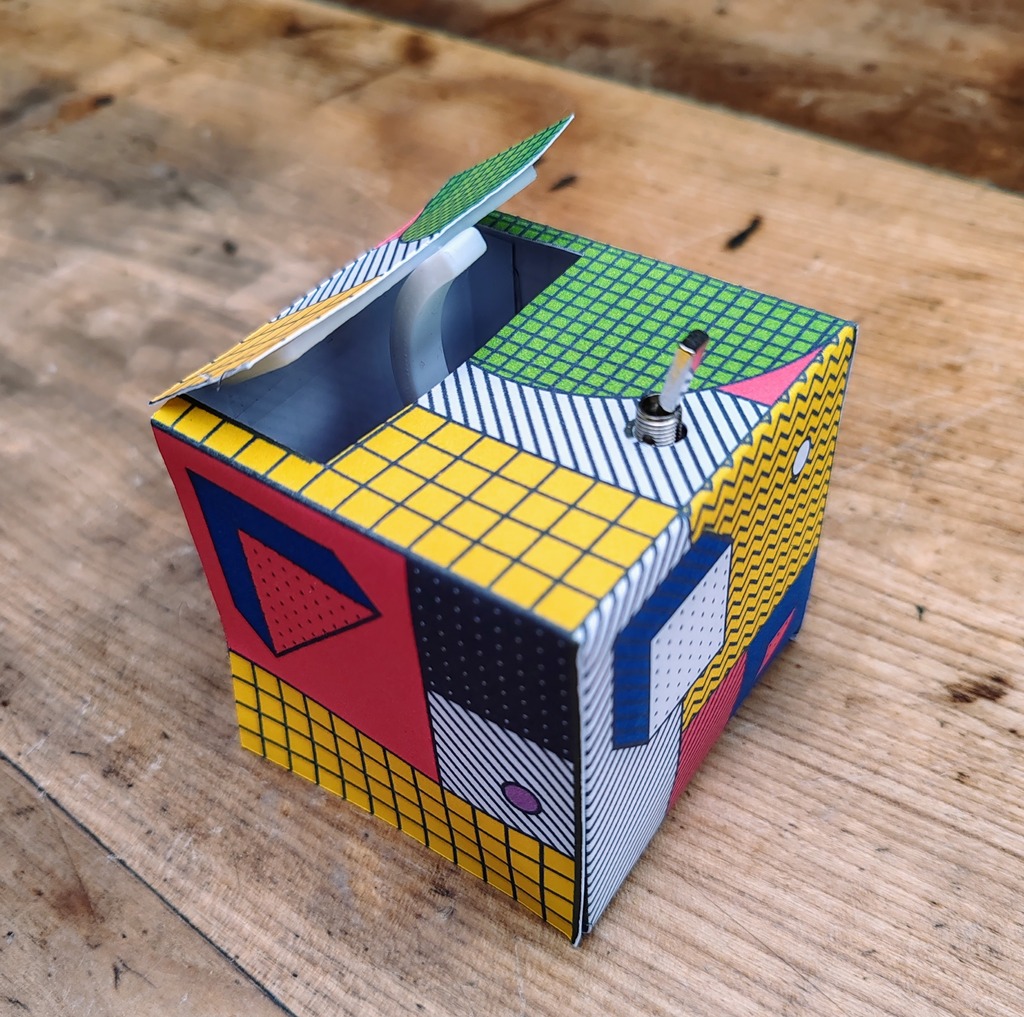
Le design retenu est d’inspiration Memphis. Pas Memphis Tennessee mais le mouvement Memphis. Le groupe Memphis a été fondé dans les années 1980 autour du designer italien Ettore Sottsass (il y a un podcast sur lui ici). C’est d’ailleurs une heureuse coïncidence parce qu’il y a deux ans, j’avais vu l’exposition qui lui avait été consacrée au centre Georges Pompidou et j’avais acheté le catalogue dont le titre était “L’objet Magique”.
Voici donc, en avant-première, le design de la machine avec de possibles déclinaisons.

Elium a aussi réalisé un prototype fonctionnel avec les éléments électroniques de mon second prototype. Une vidéo est visible ici (c’est un prototype sans batterie pour celles et ceux que le câble USB chagrine).
On entre désormais dans la phase d’industrialisation, qui consiste à trouver un fabricant et à étudier tous les détails de fixation des éléments à l’intérieur de la boîte (vous ne voulez pas savoir comment ça tient, là).
Comme toujours, se pose la question du lieu de fabrication. Pour l’instant, on discute avec un fabricant normand (même si je suis breton) et un fabricant chinois (même si je suis breton).
Le site (sérieusement)
En mai, a aussi débuté le travail sur le site, le vrai – pas celui des ami.e.s –, travail réalisé par Pascale Moise qui est, entre autres, l’autrice du Minimit, mais qui est surtout développeuse de sites. Elle a eu l’idée d’un site qui s’ouvre quand on actionne un bouton.

L’édition « Paper toy »
Suite aux différents ateliers évoqués plus haut, j’ai affiné la version carton de la machine pour pouvoir en faire une série très limitée (pas plus d’une dizaine d’objets, en réalisation artisanale) destinée à celles et ceux qui veulent pouvoir s’amuser dès maintenant, mais surtout tester les différentes chorégraphies faites de mouvements et de sons à concevoir dans les prochains mois.
C’est une version à monter soi-même, basée sur la même architecture électronique que la version finale (mais sans la batterie) et que j’imagine vendre dans les 100 € avec 50% de réduction sur la version finale de la machine quand elle sera disponible. Si vous voulez en savoir plus ou si ça vous intéresse, écrivez-moi !
Voici le kit et à quoi ressemble la machine en carton (ça peut devenir un collector, qui sait !).


Et les Lego ?
Loïc était occupé jusqu’ici à terminer son Master (c’est fait) et il a débuté en juin les premiers essais de la version lego. On a passé une après-midi à voir comment y intégrer le moteur, le bras et l’interrupteur, ce qui se fera avec des pièces spécifiques imprimées en 3D. Il y aura environ 300 pièces dans le kit et bien sûr l’électronique, le moteur, le haut-parleur, la batterie et… l’interrupteur.

Maker Faire
Avec mon ami François Xavier Faucher (FXF), que beaucoup d’entre vous connaissent via le fabuleux blog Toyfab, nous avons décidé de prendre un stand à Maker Faire Lille et de réaliser une boîte inutile géante.
C’est le weekend du 19/20 novembre et c’est donc à Lille. Venez nombreux !
Voici une première idée de FXF. Il sait faire les choses en grand.

Next
Maintenant que l’électronique est terminée, que le logiciel a déjà son repository Github (l’ensemble du code sera « Open-source »), que le site est en bonne voie et que le design est figé, il reste deux très gros sujets : les comportements de la machine et le financement.
Les comportements
Paul a développé un langage de description des comportements comportant chorégraphie du bras et lancement de séquences sonores, mais je n’ai pas encore eu le temps de travailler sur cet aspect-là. J’ai besoin d’avoir les idées plus claires ne serait-ce que sur la direction artistique. Pour l’instant, j’oscille entre la boîte à meuh et l’IRCAM : il va falloir resserrer un peu je crois.
Il y a beaucoup à faire parce que chaque machine est unique : l’idée est d’avoir suffisamment de sons et de comportements pour qu’on puisse, au moment de la fabrication, en tirer au sort quelques centaines pour chaque boîte. Il faut donc trouver la façon de décliner mouvements et sons par milliers. C’est notamment ce que j’aimerais tester avec l’édition « Paper toy ».
Le financement de la production (a.k.a. L’Argent)
Dans la production d’objets électroniques, il y a deux sortes de coûts : les coûts d’investissement que l’on appelle dans le jargon les NRE (Non Recurring Expenses) et les coûts unitaires liés à la fabrication de chaque machine. Dans le cas de la fabrication de cartes électroniques, il y a très peu d’investissement à réaliser; en revanche, dans le cas de pièces plastiques, si l’on utilise des méthodes d’injection, il faut réaliser des moules dont le coût est fonction du design. Et le design en cube impose un outillage plus complexe que la moyenne.
Deux options s’offrent donc : financer moi-même la production ou réaliser des préventes qui servent à couvrir les investissements et la production. J’ai longtemps pensé que je pouvais sortir le produit en auto-finançant le projet, comme je l’ai fait pour le MiniMit. La commercialisation en aurait été vraiment simplifiée : vous l’achetez et vous le recevez tout de suite. Mais en calculant les investissements nécessaires pour produire la machine, j’ai compris que ce ne serait pas possible (il faut toujours une petite part d’aveuglement pour se lancer).
Sauf si ici un.e ami.e veut investir ou aider, je vais partir sur un système de préventes via une campagne de financement participatif (Kickstarter a priori). Je connais assez bien ces dispositifs et ce sera ma sixièmecampagne !
Une campagne de financement participatif signifie ni plus ni moins qu’il faut passer de 400 ami.e.s à 5000 ! La clé du succès, c’est d’atteindre l’objectif dès le premier jour, sinon on s’enlise assez vite, il faut sortir les rames et ça devient pénible pour tout le monde.
Comment passer de 400 à 5000 ami.e.s ? Eh bien c’est la question à 1000 Francs et s’il y a des expertes ou experts en marketing digital, je veux bien vous appeler pour papoter parce que si la mécanique n’est pas mon fort, le marketing non plus !
☀️
Merci à toutes et à tous d’avoir lu jusqu’ici !
Dites-moi si vous voulez un badge, si les paper toys vous intéressent et n’hésitez pas à m’aider pour agrandir notre communauté !
Et on termine avec la bande-son :
« Oh, I get by with a little help from my friends
Mm, get high with a little help from my friends
Oh, I’m gonna try with a little help from my friends«
With A Little Help From My Friends – The Beatles
Olivier